

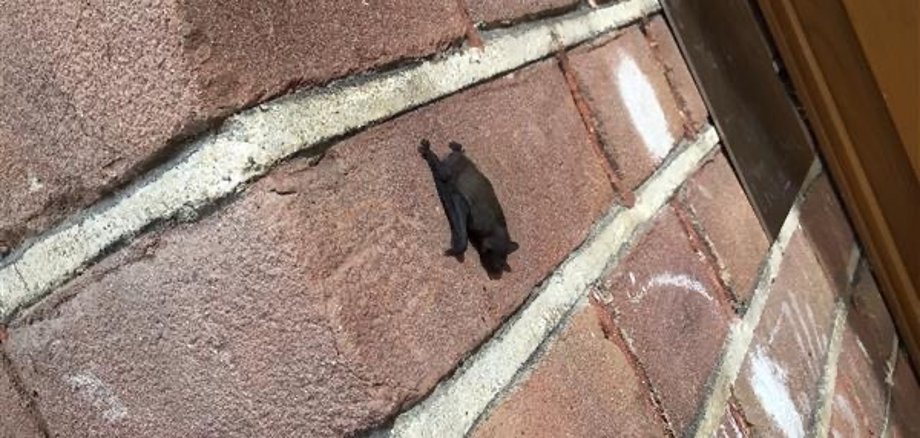
The news quickly spread throughout the school. Shortly afterward, the area was cordoned off. All the children who walked by were very considerate of the little wild animal and quietly watched it from a distance. You shouldn’t just go around touching wild animals. So Ms. Kappelhoff and Ms. Immink showed the children close-up photos of the animal, in which the young explorers could see that it must still be very young because it didn’t have any fur yet.
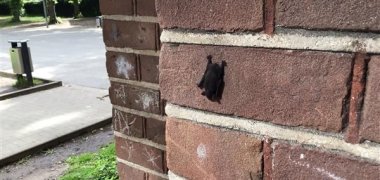
But what do you do with a bat you’ve found? Bats are protected by law. That means you’re not allowed to disturb, capture, injure, or kill them. The bat couldn’t just stay on the wall. A young bat like that wouldn’t survive. Ms. Mönninghoff, Ms. Oruç-Kerem, and Mr. Koch called bat experts as far away as Berlin and gathered all the information needed for the rescue. After receiving some valuable tips, they learned through the Borken district branch of NABU (Nature Conservation Union) that there is a volunteer bat expert in Ahaus. When she heard about the find, she came to Gronau immediately and examined the animal. The children’s hunch was correct: the little bat was still a baby and only one week old.
The expert then very carefully removed the animal from the wall using a cloth. Now the children could marvel at the young bat up close and learn that it was a pipistrelle. The expert took the bat home with her for the day to care for it. That same evening—shortly before sunset—she met with Ms. Neumann at the school to carry out a special plan: The young bat was placed on a comfortably warm hot water bottle. The plan was for the bat to stay there. Sometimes young bats call out for their mothers. With a bit of luck, their mothers will come and pick them up again. Unfortunately, the little bat had no luck that night.
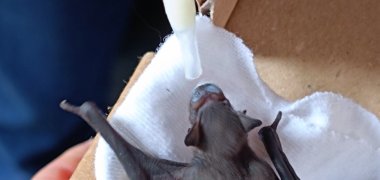
The next day, Ms. Neumann warmed the animal following expert instructions and fed it special puppy milk. The topic was also discussed in class: The children learned what supplies are needed for a rescue, researched bats, and made drawings. Some children were able to observe the care process up close. The little bat seemed to feel very comfortable at Lindenschule, as it became a bit more active over time. After another unsuccessful attempt to have the animal picked up by its mother, the bat was finally picked up by the expert. She will now take good care of the animal
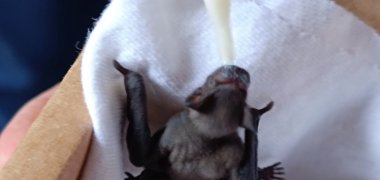
take care of. Young bats like this need very special care. For example, they must be fed milk every two hours. Later, they’ll be fed maggots. In addition, the little bat from Lindenschule is now living with other bats. That’s doing her a world of good. We’re glad the rescue operation went well, thank the expert for her wonderful help, and wish the bat all the best. In August, she might even be released back into the wild at the Lindenschule.
For more information, visit www.fledermausschutz.de
Please click for a larger view of the photos!